I get this question a lot. People email me, they DM me on Instagram, they corner me at REI when they spot the Nepal sticker on my Nalgene. They want to know how Everest Base Camp stacks up against Kilimanjaro. Usually it is because they did Kili a few years ago, loved it, and now they are eyeing the Khumbu.
I am the right person to answer because I did them in that order. Kilimanjaro first, then Elbrus, then a few more trips, and eventually Everest Base Camp. I have been back to Nepal seven times since 2012, so EBC was just one of several trips, but that spacing matters. Kilimanjaro was my reference point when I walked into the Khumbu for the first time, and the comparison kept running in my head the whole way up.
So here is the honest version. No marketing copy, no false equivalence. Just what I actually thought, in the order I thought it.
| Quick Comparison | Everest Base Camp | Kilimanjaro |
|---|---|---|
| Trip style | Teahouse trek with villages | Expedition-style with camping each night |
| Trail days | 12-14 | 5-8 |
| Max elevation | 5,545 m (Kala Patthar) | 5,895 m (Uhuru Peak) |
| Difficulty | Moderate-Hard | Hard |
| Vibe | Sherpa villages, mountain community | Self-contained expedition bubble |
| Cost (package) | $2,000-3,200 | $2,500-4,000 |
| Best for | Cultural depth + Everest | Single-mountain summit objective |
Use this to skim, then read on for the honest answer.
The altitude reality
Kilimanjaro tops out at 5,895 meters. Everest Base Camp sits at 5,364 meters, and most people add Kala Patthar at 5,545 meters for the actual Everest view. So on paper, Kili is higher.
In practice, EBC is harder on your body, and it is not close.
Here is why. On Kilimanjaro you have six to eight days, depending on the route, and you are climbing more or less straight up. Even on the longer Lemosho or Northern Circuit routes, you do not really get a meaningful rest day. You sleep at altitude, then go higher, then sleep higher, then summit. Your body never catches up. The summit night is brutal, and a real chunk of people turn around or get pulled off the mountain.
On EBC you have twelve to fourteen days, with two built-in acclimatization days (one at Namche Bazaar, one at Dingboche), and you are following a “climb high, sleep low” pattern that is closer to how acclimatization is actually supposed to work. By the time you hit Gorak Shep, you have been over 3,000 meters for a week. Your body has had a chance.
Result: Kilimanjaro has a higher summit but a much higher altitude failure rate. EBC keeps you up there longer, which is exhausting in a different way, but you usually make it.
The felt difference
Both are hard but doable with the proper training and gear, so the felt difference is not really about which is “harder.” It is about what kind of trip you are signing up for.
Kilimanjaro felt like a British expedition. A fleet of porters and guides, camping each night, a fairly closed bubble that moves up the mountain together. EBC is the opposite. You sleep in teahouses with strangers, you eat dal bhat next to people on their own version of this trip, you trade beta with parties going up and coming down, you watch a yak train shoulder past you on a stone path.
There is a community quality to the EBC trek that does not exist on Kilimanjaro, and for me that is the bigger reason to do EBC. The mountain views are stunning on both. The human texture is only there on one.
Duration and pace
Kilimanjaro is a sprint. EBC is a marathon.
You can knock out Kili in six days. People do five-day Marangu trips, which I would never recommend, but they exist. That means you fly into Tanzania, do the climb, and you are back home inside two weeks of total travel.
EBC is a different commitment. You need fourteen days for the trek itself, plus buffer days for the Lukla flight (which gets canceled, frequently), plus Kathmandu time on both ends. Realistically you should plan three weeks off work. If you have only ten or eleven days of vacation, EBC is going to be hard to do right.
This is a real consideration. The people who tell me they did EBC in nine days are usually the same people who tell me they hated it. You cannot rush the Khumbu.
The scenery, and why it matters
Here is where they diverge most. Kilimanjaro is a single mountain. A volcano, actually, rising out of the Tanzanian savanna. You climb through five distinct ecological zones, from rainforest to alpine desert to a glacial summit. The views are incredible but they are also kind of inward. You are climbing a thing.
The Khumbu is an amphitheater. You are walking through the highest mountain range on earth, with eight-thousand-meter peaks closing in around you. Ama Dablam looms over Tengboche. Lhotse and Nuptse frame the view from Pheriche. By the time you crest the ridge before Gorak Shep, you are inside a cathedral made out of ice and granite. The Khumbu Icefall is right there. Everest is right there.
I am not going to pretend this is a fair fight. Kili is a beautiful climb. The Khumbu is a religious experience.
Summit fever vs Base Camp reality
This is something nobody tells you. Kilimanjaro has a peak. You stand on Uhuru Peak and there is a sign and you took the picture. There is a moment.
EBC, in the most literal sense, is anticlimactic. Base Camp itself is a moraine, a pile of rocks. In trekking season there is nobody there (the climbers are not in residence in November or March). You walk up, you find the rock that says “Everest Base Camp 5364m,” you take the picture. That is it.
The actual moment of the trek is the next morning, when you climb Kala Patthar at sunrise and watch Everest catch the first light. That is the photograph. That is what closes the case on the whole thing.
So if you are someone who needs the summit, Kili might satisfy you more. If you are someone who comes for the journey, EBC will wreck you in the best way.
Cost
Kilimanjaro is more expensive per day, by a lot. You are looking at $2,500 to $4,500 for a guided climb, all-inclusive, depending on route and operator. That is for six to eight days of climbing.
EBC runs $1,800 to $3,500 for a full guided trek, depending on operator and season. That is for twelve to fourteen days on the trail, plus Kathmandu logistics, plus the Lukla flight.
So Kili is shorter but more expensive per day. EBC is longer but cheaper per day. Roughly speaking, the trip costs end up in the same neighborhood, with EBC slightly cheaper for a much longer experience.
For the full breakdown on what Nepal actually costs in 2026, I wrote a detailed cost guide here.
The porter welfare conversation
I have to bring this up because it is real. Kilimanjaro has a well-documented porter welfare problem. Underpaid porters, inadequate gear, dangerous loads. There are good operators and the Kilimanjaro Porters Assistance Project (KPAP) has been pushing reforms for years, but if you do not specifically look for a KPAP-affiliated operator, you may be participating in a system that is genuinely exploiting people.
In Nepal, the porter situation is not perfect but it is structurally better. Wages are higher relative to local cost of living, there are weight limits enforced on the main trails, and the good operators (the kind I work with) treat porters as career staff with insurance and equipment.
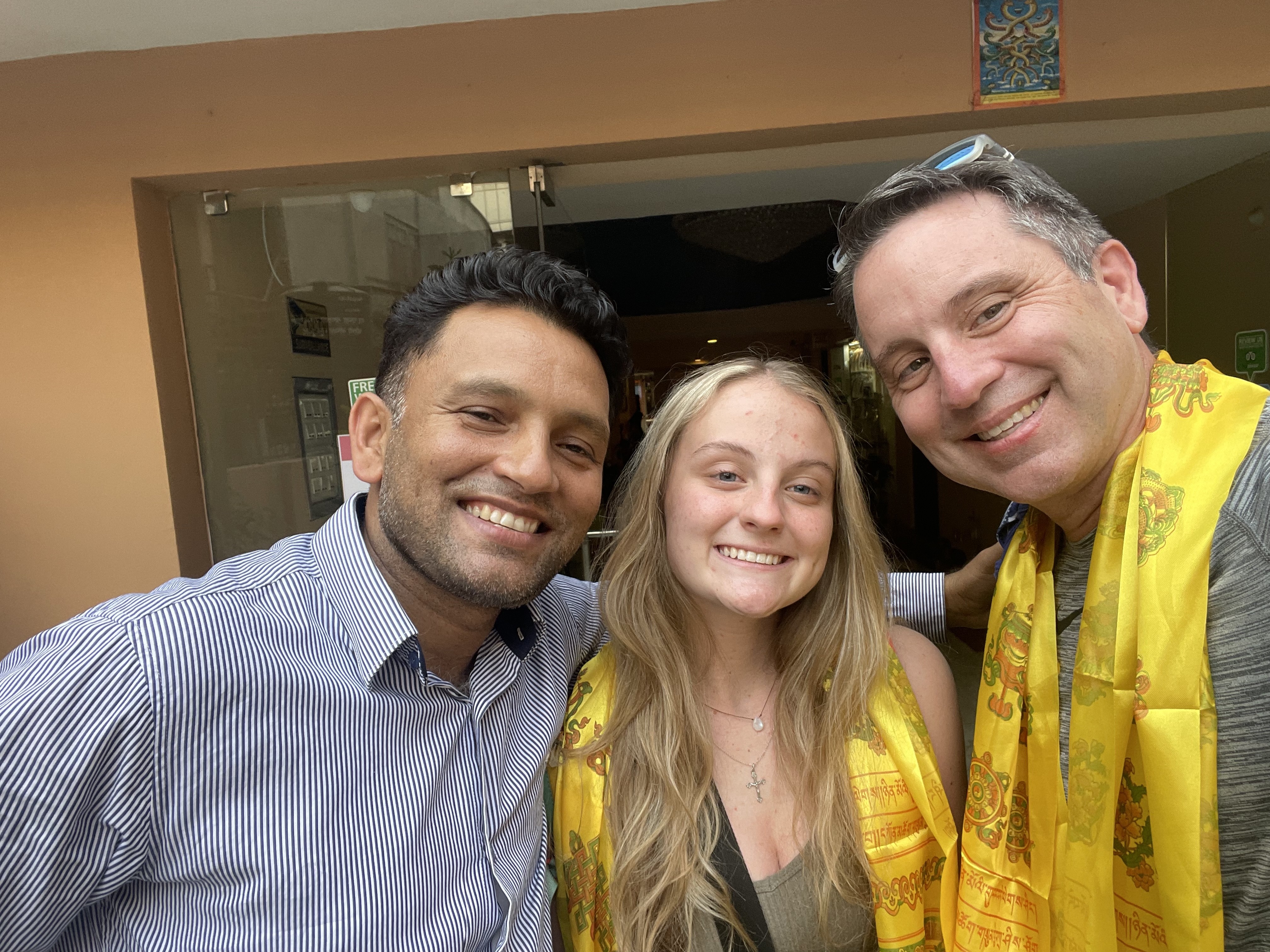
This was actually one of the things that pushed me toward working with Naba’s outfit, Third Rock Adventures. He pays porters and guides as full-time staff, not gig labor. Disclosure: I have a referral arrangement with Third Rock. They are who I send people to, and I make a small fee if you book through me. I would send people there regardless, because I have known Naba since 2012 and he has personally pulled me out of more than one situation. He once arranged a helicopter rescue from Lukla for me, but that is a story for another post.
So which should you do first?
If this is your first big trek and you have never been over 4,000 meters, I genuinely think EBC is the better starter. The longer acclimatization profile is more forgiving, the trail is well-supported, and the teahouse culture means you are not camping in the cold every night.
Kilimanjaro is the better trip if you have only ten days off work, you want a clean summit photo, and you are okay with a tougher altitude profile.
If you have done Kili and you are wondering whether EBC is going to feel redundant, it will not. They are entirely different experiences. EBC is the bigger trip, in every sense that matters.
For the difficulty side of this conversation specifically, I wrote a full piece on how hard EBC actually is that goes deeper than I can here. And if you are still torn between EBC and other Nepal options, the EBC vs ABC comparison is the next post you should read.
The verdict
I will give you the answer I give my friends. Kilimanjaro is a great trip. EBC is a life trip. If you can only do one, do EBC. If you have done Kili and you are wondering whether to go to Nepal, stop wondering and go.
Not sure which Nepal trek is right for you? Take the two-minute quiz and I will point you in the right direction. Or just reach out directly and I will tell you what I would do if it were me.